
Join early access
Early accessSandbox liveUpdated 2026-10-01

AI can work.
Pink lets it spend safely.

Pink Agentic AI Payments is the approval layer between AI agents and company money. An agent asks "may I pay this?"; the rules you set once answer in under a second: allow ask a person block. The agent never sees a card number or a bank login.

Self-serve sandbox, test credentials only. Or open the interactive demo and press "Simulate a day".

Pink console overview: a day of agent payment requests, each allowed, asked or blocked with its reason, next to every agent's budget
The console after a day of agent spending. Every row says which rule decided and why.

Works with the AI you already use

Connect it in minutes. Click one for the guide.

Chat apps sign in with Pink in a browser. Coding tools and frameworks take an agent key. Every guide has numbered steps and screenshots of what you will see.

All 15 connection guides →

Agents can act. Nobody lets them pay.

A purchasing agent knows the beans run out on Thursday. An engineering agent knows the API credits are gone. An ads agent knows this creator batch is returning 4.6×. Each stops at the same wall: someone has to pay. Giving the agent a company card means a bug, a leaked key or a bad prompt can spend everything. Routing every payment to a person means the agent waits and finance drowns in $40 approvals.

allow

Clears on its own

Routine spending inside the rules: a $420 bean order from an approved supplier, a $300 ad top-up under the daily cap. A single-use credential is issued at once.

ask a person

Only the exceptions reach you

A $7,400 supplier balance to a bank account that changed last week, a $58,000 deposit. The right person gets a push with the rule, the agent's reason and the evidence.

block

Stops without asking

Gift cards. A refund before the return was scanned. API credits past the daily stop at 3 a.m. No approval path on purpose: a bug cannot talk its way through.

See it work

The product, not a mock-up. Every screen below is in the interactive demo and, with real keys, in the sandbox.

Policies: thirty rules in plain words with agent, payee, amount window and the action, in evaluation order

Policies

Rules in the words a finance team uses

Which agent, paying whom, how much, over what period, and what happens. Checked top to bottom, first match decides, anything uncovered is blocked. Rules can require evidence (a matching PO, a signed brief, a warehouse scan), react to risk signals (a payee's bank details changed, a duplicate invoice), and depend on currency or time of day. The e-commerce sample runs 30 of them.

How rules are written →
Policy Copilot: a chat that asks six to eight questions and turns a typed sentence into two rules, with the policy draft building on the right

Policy Copilot

Set up by conversation, not by form

Six to eight questions, about four minutes. Or type a sentence: "Ops AI can pay contractors up to $3,000, above that the CFO approves" becomes two rules with the right approver. Publishing creates a numbered policy version; every past payment stays tied to the version that decided it.

Try the Copilot in the demo →
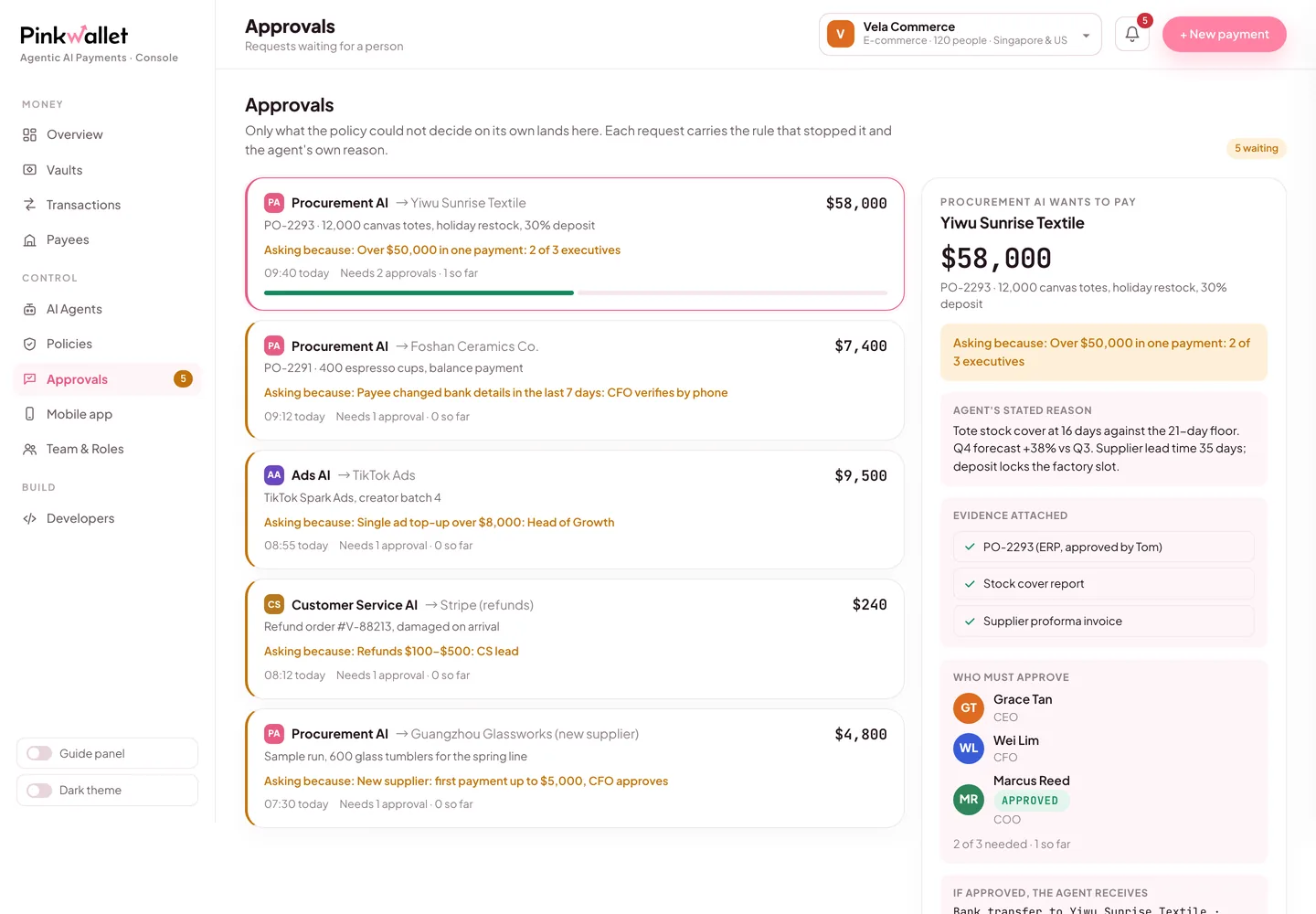
Approvals: a $58,000 request needing two of three executives, with the agent's reason and evidenceThe mobile app showing one request with Approve and Decline

Approvals · Mobile app

People decide only what the rules could not

Each request carries the rule that stopped it, the agent's stated reason and the evidence it attached. Approval groups can require two of three executives. The phone app does one thing: approve or decline. No balances, no settings. If nobody answers before the timeout, the request is declined; nothing is approved by silence.

Test a payment: a dry run showing the decision path step by step, ending in ask the CFO because the payee changed bank details

Test a payment

Ask the policy before an agent ever tries

Pick an agent, a payee, an amount and the evidence on the request. The same engine runs and shows every step: registered, active, within budget, within the daily ceiling, vault funded, then each rule skipped, matched or stopped. Agents get the same dry run as pink.check_policy.

Vaults: money split by purpose in six currencies, each vault listing which agents may spend from it

Vaults · Agents

Money by purpose, agents on a leash

USD, EUR, GBP, HKD, SGD and JPY in the same vault. An agent can only spend from the vault it is attached to, under a monthly budget and a single-payment cap, and can be paused in one tap. A reserve vault with no agents is money AI can never reach.

Built for every size of company

Three sample companies ship in the demo and the sandbox. Twenty-five industry setups show what their agents would pay for and the rules that keep them safe.

Coffee shop

Bloom & Bean

4 agents · 11 rules. Supplies under $500 clear, $500–$2,000 ask the store manager, ads $300 a day, nothing after 11pm, gift cards never.

Startup · 50 people

Northstar Labs

6 agents · 17 rules. API credits $200 a day then stop, CFO tier $1,000–$5,000, two of three leaders above that, ads $20,000 a month then stop.

E-commerce · 120 people

Vela Commerce

7 agents · 30 rules. PO matching, duplicate invoices, payee bank-detail changes, HKD and JPY rules, refund tiers, creator briefs, carrier statements.

All industry setups →

Connect any agent in two minutes

Pink is a remote MCP server. Claude, ChatGPT, Gemini CLI, Cursor, VS Code, Copilot Studio, the OpenAI Agents SDK, LangChain, CrewAI, n8n and anything built on the official MCP SDKs connect with one URL and one key. There is a plain REST mirror for everything else.

Cursor · VS Code · any mcp.json
{
  "mcpServers": {
    "pink": {
      "url": "https://agentic-sandbox.pinkwallet.com/mcp",
      "headers": { "Authorization": "Bearer <AGENT_KEY>" }
    }
  }
}

Seven tools, one payment lifecycle

  • pink.get_budget what this agent may still spend
  • pink.list_payees · pink.list_rules who it may pay, which rules apply
  • pink.check_policy dry run: would_allow / would_ask / would_block
  • pink.request_payment allowed with a credential, pending_human with a hold, or blocked
  • pink.get_credential poll the hold until a person decides
  • pink.report_receipt close the loop, raise the trust score

How a payment request is decided

  1. 1
    Circuit breakers first. Is the key registered? Is the agent paused? Would this exceed the agent's monthly budget or the company's daily ceiling? Does the vault hold the money? Any "no" ends the request before a single rule is read.
  2. 2
    Rules top to bottom, first match decides. Fraud controls first (bank-detail changes, duplicate invoices), then amount tiers, then domain rules for ads, suppliers, carriers, refunds, SaaS.
  3. 3
    Three outcomes. Allowed returns a single-use credential locked to that payee and amount. Pending returns a hold a person decides on the phone. Blocked returns the reason and nothing else.
  4. 4
    Everything is recorded. The rule, the policy version, the approver, the credential, the receipt. Blocked requests stay in the log too.

Where it sits

Card networks and protocol groups are defining how an agent presents a payment: Visa Intelligent Commerce, Mastercard Agent Pay, Google's AP2 mandates, Stripe's agentic commerce. Those answer how an agent pays a merchant. Pink answers the question that comes before it: inside a company, who may let this agent pay this, under what rules, and who signs off when the rules are not enough. Because the credential Pink issues is a normal card or a normal bank transfer, every supplier already accepts it. No protocol has to win first.

Capability comparison by category
CapabilityPinkCrypto custody platformsAgent payment protocolsCorporate card platformsPayment APIs
Made for AI agents as the spender●○●○◐
Fiat first: bank transfers and cards in six currencies●○◐●●
Rules in plain language, set up by conversation in minutes●○○◐○
Evidence conditions: PO match, statement match, duplicate invoice, payee bank-detail change●○○◐○
Human approval chains (2 of 3, by group, by amount, by time of day)●●○◐○
Works with any merchant, no integration on their side●○○●◐
Circuit breakers: daily ceiling, runaway agent, unknown key●◐○◐○
Approve on the phone, one tap, nothing else exposed●●○●○

● yes · ◐ partly · ○ no. By category, from public information as of September 2026.

FAQ

What is Pink Agentic AI Payments?

It's the approval layer between AI agents and company money — a business wallet, a rule engine, and an approval flow. It decides whether an agent may make a given payment, and if the rules allow it, issues a one-time credential for that payment only.

Is it live today?

Yes, as a public sandbox. Since 2026-09-30 the MCP server and REST API are live at https://agentic-sandbox.pinkwallet.com/ with test credentials, and no real money moves. An interactive demo console with sample companies is at https://pinkwallet.com/agentic/demo/index.html. Production, with real vaults and real credentials, is not yet available. Early access is open now.

Which rails and currencies does it support?

It's fiat first. Funding, conversion, and payouts are designed to run on PinkWallet's existing bank rails and card issuing, across six currencies: USD, EUR, GBP, HKD, SGD, and JPY. What an agent receives is a normal bank transfer or a normal card — no merchant integration is required on the other side.

Does this replace protocols like x402, AP2, or ACP?

No. Those protocols define how an agent pays — the mechanics of a transaction. Pink decides whether an agent may pay at all: the policy layer that sits before that transaction happens.

How does an agent connect?

Through the MCP server or REST. The flow is check first, request, collect the credential, file the receipt — the agent never touches the money directly. This is part of the next build stage (sandbox), not live yet.

What happens if no one approves a request in time?

It's declined. No answer is a no — nothing is ever approved by silence.

Can an agent get around the spending rules?

By design, no. An agent holds only a key — never a card number or a bank login — and every request runs through the same check: registered, active, within budget, within the daily ceiling, vault funded, then each policy rule in order. Anything not covered by a rule is blocked by default.

Who sets the rules, and can they change?

Your own team, in finance-team language — by conversation (a short set of questions) or by typing a plain sentence. Each published set of rules becomes a numbered version, and every past payment stays tied to the version that decided it.

Is this connected to PinkWallet's existing accounts?

Yes. Pink Agentic AI Payments is designed to run on PinkWallet's existing bank rails and card issuing for funding, conversion, and payouts.

How do I get access?

Early access is open now — use the sign-up form on this page to join.

Go deeper